

Building resilience in private wealth structures: a long-term perspective
23 March 2026
Families are more internationally mobile, assets are more globally distributed, and regulatory expectations are more transparent and interconnected than ever before. The emphasis now with our clients is ensuring that structures are efficient and resilient across multiple jurisdictions, generations and regulatory environments.
This shift calls for a more deliberate, long-term approach to structuring, grounded in governance, clarity and adaptability.
Increasing global complexity
The operating environment for private wealth has evolved significantly over the past decade. Families now often hold assets, businesses and residences across several jurisdictions, each with its own legal, tax and regulatory framework.
At the same time, international coordination between tax authorities has increased, and reporting requirements have become more sophisticated. Structures that may once have appeared straightforward can now create unintended consequences when viewed through a multi-jurisdictional lens.
Complexity is now the norm, and structuring must consider how different systems interact, rather than optimising for one regime.
Multi-jurisdictional families
It is increasingly common for family members to live, work and hold citizenship or residency rights in different countries, which creates both opportunity and challenge. While geographic diversification can support lifestyle and business flexibility, it can also introduce layers of tax exposure, succession considerations and reporting obligations that require careful coordination.
Structures should therefore be designed to accommodate movement, not only of assets, but of people. Flexibility becomes just as important as efficiency, and governance frameworks need to be healthy enough to support decision-making across borders.
Regulatory transparency
The global regulatory landscape has undergone a profound transformation. Initiatives such as automatic exchange of information, enhanced disclosure regimes and beneficial ownership requirements have significantly increased transparency.
This has also reshaped the role of international financial centres. Reputable jurisdictions are no longer viewed as opaque environments, but as regulated and compliant platforms that help families manage cross-border complexity in a considered way.
For families, this means structuring is no longer about minimising visibility. It is about ensuring clarity, compliance and defensibility. Well-designed structures should be able to withstand scrutiny from multiple regulators while continuing to deliver practical benefits in areas such as governance, asset protection and succession planning.
Intergenerational planning challenges
Perhaps the most significant driver of structural complexity is generational transition with differences in geography, outlook and objectives often become more pronounced.
Structures must therefore do more than hold assets. They must support continuity through clear governance frameworks, defined roles and responsibilities, and mechanisms for managing change over time.
Tools such as trusts, foundations and private trust companies can all play an important role in this context. Their effectiveness, however, depends on how closely they are aligned with the family’s long-term objectives, circumstances and dynamics.
A framework for resilience
In this environment, the most effective approach to structuring is one that prioritises resilience over short-term optimisation.
Where the following questions can be answered, a structure is far more likely to endure:
- Is the current structure coherent across all relevant jurisdictions?
- Does it provide sufficient flexibility to accommodate changes in residence, regulation or family circumstances?
- Are governance and decision-making processes clearly defined and understood?
- Does the structure support long-term succession planning and intergenerational transition?
- Are reporting and compliance obligations manageable and sustainable?
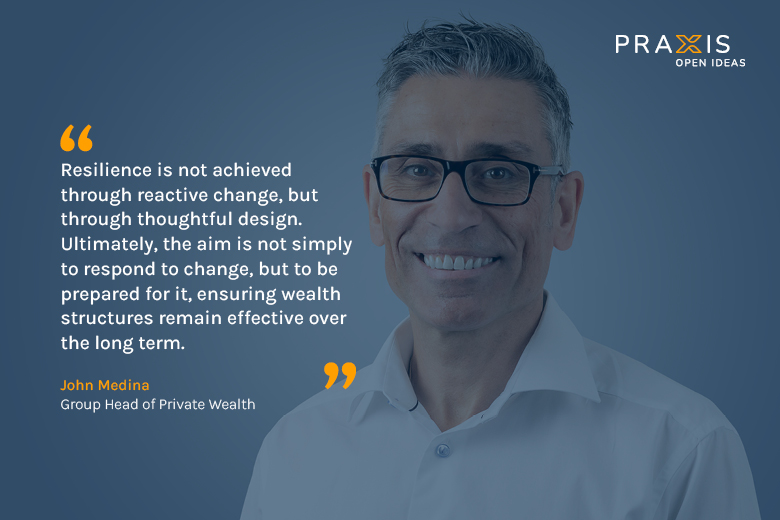
In this context, resilience is not achieved through reactive change, but through thoughtful design. Ultimately, the aim is not simply to respond to change, but to be prepared for it, ensuring wealth structures remain effective over the long term.
For more information on our private wealth services, please reach out to John Medina.
Please note that this article is intended to provide a general overview of the matters to which it relates. It is not intended as professional advice and should not be relied upon as such. Any engagement in respect of our professional services is subject to our standard terms and conditions of business and the provision of all necessary due diligence. © Praxis 2026
Key contact