
The role of corporate governance in private wealth structures
An effective corporate governance framework plays a vital role in ensuring the longevity and resilience of private client structures.
In this interview, Trust Supervisor Gireeja Bhoobun shares her insights on how governance supports long‑term decision‑making for private clients, and how her voluntary role as Marketing Lead with the Corporate Governance Institute (CGI) Jersey Branch enhances her professional perspective.
What has been your career path?
After graduating with a BA (Hons) in Law and Management in 2017, I completed an LLM in Corporate and Insolvency Law at Nottingham Trent University. My interest in corporate governance deepened while interning at a London start‑up focused on governance reporting for banks, FTSE‑listed companies and regulators. I completed an MSc in Corporate Governance with Distinction before returning to Mauritius in 2020, where I worked full‑time as a Trust and Company Administrator and lectured part‑time in Governance and Ethics at a local university.
In February 2019, I joined the CGI (formerly ICSA), by enrolling to the Chartered Governance Qualifying Programme, via the fast-track professional entry route, which promotes high standards and supports the development of governance professionals.
I moved to Jersey in 2021 and joined Praxis’ private wealth team in January 2024, managing a range of fiduciary structures. Following my promotion to Trust Supervisor in January 2025, my focus has shifted to helping clients design governance frameworks that reflect how they truly operate across jurisdictions, generations and asset classes to support effective long-term decision‑making.
How is corporate governance evolving in private client structures such as trusts, family offices and privately held companies?
Governance now extends beyond the public-company model of board committees and formal reporting. For trusts, family offices and privately held companies, it is increasingly about managing relationships, expectations and long-term objectives.
In these structures, the risks are more personal: unclear decision rights, misaligned family expectations, conflicts between commercial and fiduciary roles, or silence around succession. Good governance brings these issues into the open before they can develop into disputes.
What are the most common governance challenges encountered by private clients and their advisers, and how does good governance help address these?
A common challenge in private wealth and fiduciary structures is lack of clarity around roles and responsibilities. Founders often hold multiple positions - settlor, director, beneficiary and informal decision‑maker - while advisers may assume oversight lies with someone else. This can lead to decisions being made without the proper authority, limited record-keeping of trustee or board actions and inconsistent communication between advisers. Over time, the governance framework can become outdated, no longer reflecting the family’s size, complexity or global footprint.
In a recent case, following the death of a Settlor, we received a request to terminate a trust and distribute the fund to four adult Beneficiaries, each tax resident in a different jurisdiction. From the outset, our focus was on governance - ensuring actions aligned with the Trust Deed, the Settlor’s wishes, and our fiduciary duties. Led by Praxis' Executive Director, Helen Hendy, we asked the right questions early, sought professional tax advice in each jurisdiction, and maintained open communication with the Beneficiaries. This allowed us to develop a fair, well-documented distribution policy that supported informed decision-making, met compliance obligations across borders, and protected the long-term interests of all parties involved.
Effective governance makes roles explicit, aligning authority with responsibility, and establishing clear processes for decision‑making and escalation. In many cases, the greatest value lies in asking the right questions early, which is the approach we take at Praxis.
How can governance frameworks add value for families and entrepreneurs beyond meeting regulatory requirements?
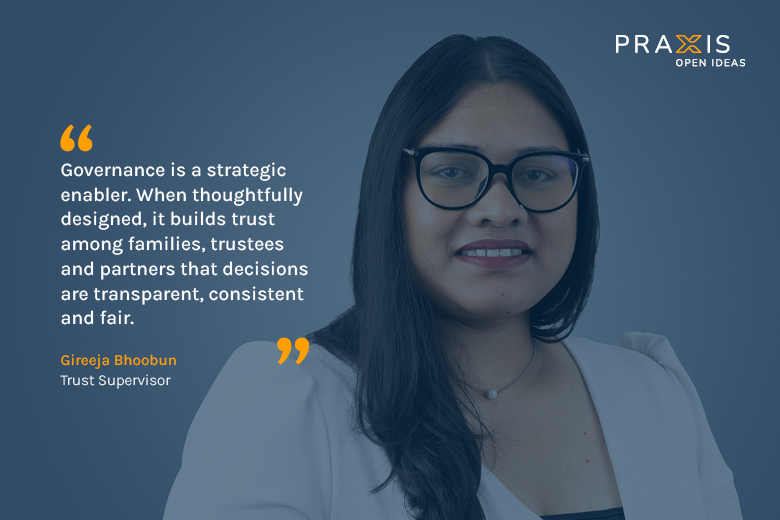
Governance is a strategic enabler. When thoughtfully designed, it builds trust among families, trustees and partners that decisions are transparent, consistent and fair. Strong frameworks also simplify succession planning and reassure stakeholders that risk oversight is in place.
Families with clear charters, structured committees or defined shareholder agreements are shown to better manage change. A good family charter can set expectations for values and conduct, and an effective investment framework can balance ambition and discipline.
Given that many private clients work with multiple advisers and service providers, what governance practices help ensure clarity of roles and prevent conflicts or misunderstandings?
With multiple advisers, effective governance creates a single and reliable source of truth. It requires clear authority, agreed information flows and well-documented roles, and provides an audit trail explaining actions and decisions.
At Praxis, a key part of our role is supporting clients and their advisers to act cohesively, particularly where structures span multiple jurisdictions.
What skills or capabilities are important for governance professionals working with private wealth clients?
The most critical capabilities include a strong understanding of fiduciary duties, trust law, and cross-border compliance, as families increasingly operate across multiple jurisdictions and tax frameworks. Strategic thinking is essential to align governance structures with long-term wealth preservation and to anticipate any legal, reputational or operational risks.
Equally important is cultural and generational sensitivity. Multi-generational families can have differing priorities, and in our role, we must communicate effectively and mediate conflicts while respecting diverse values and perspectives.
Advisers should be able to provide clear reporting, robust decision making frameworks, and demonstrate independence. They must also be expected to keep pace with evolving regulations and digital governance tools to deliver efficient and timely solutions.
How can evolving families incorporate good governance?
As families scale in wealth, complexity and geographic reach, governance must evolve from being founder‑centric to structure‑centric.
Clear separation between ownership, management and beneficiaries, plus defined roles for trustees, boards and advisers, shifts the focus from who decides, to how decisions are made. When governance is a living framework, it reduces reliance on individuals, supports continuity and creates clearer pathways for the next wave of wealth receivers.
At Praxis, we combine deep technical knowledge with a practical, client centred approach. We work with families, trustees and advisers to create governance frameworks that are proportionate, bespoke and aligned with our clients’ objectives.
To explore how strong governance can unlock value in your private wealth structures, please contact a member of our Private Wealth team.
Please note that this article is intended to provide a general overview of the matters to which it relates. It is not intended as professional advice and should not be relied upon as such. Any engagement in respect of our professional services is subject to our standard terms and conditions of business and the provision of all necessary due diligence. © Praxis 2026