

Why governance has overtaken tax in UAE relocation planning
27 January 2026
For individuals and families relocating from the UK and Europe, the UAE - and Dubai in particular - remains one of the world’s most attractive destinations. Safety, connectivity, lifestyle and the absence of personal income and capital gains tax are well understood.
Over the past decade, Dubai has shifted from being a relocation hub driven by tax incentives to an internationally recognised governance-led, sophisticated wealth-structuring centre.
The challenge for international families sits at the intersection of residency defensibility, fiduciary structure, succession planning and regulatory compliance - areas where Dubai and Abu Dhabi have matured rapidly over the past decade and continue to evolve apace.
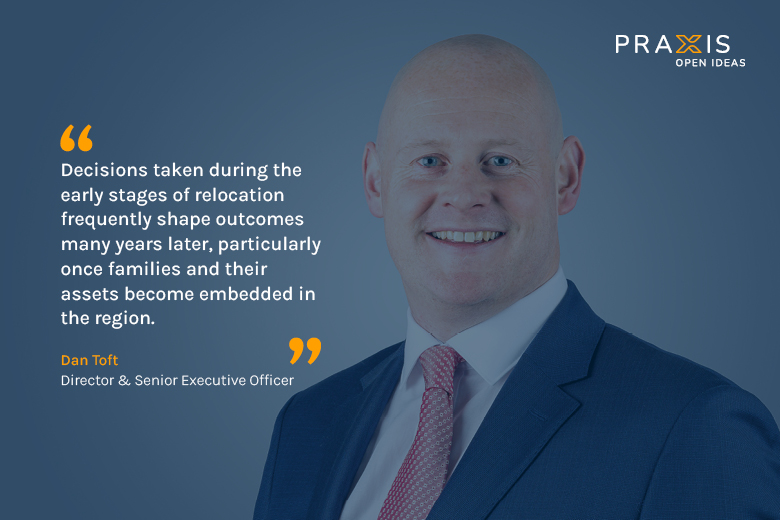
Our experience of supporting internationally mobile families suggests that navigating this challenge successfully requires a holistic governance-first approach. Decisions taken during the early stages of relocation frequently shape outcomes many years later, particularly once families and their assets become embedded in the region.
For advisers accustomed to UK and European trust, tax and regulatory frameworks, this can mean entering uncharted territory. Working with a trust and corporate services firm with a multi-lingual on-the-ground team is therefore crucial.
In practice, much of our role involves translating well-established UK and European planning concepts into structures that are locally recognised, regulated and enforceable in the UAE. This requires technical expertise combined with deep familiarity with how local regulators, banks and counterparties assess substance, control and governance in real-world scenarios.
Establishing residency
From a UK perspective, a common misconception is the assumption that UAE residence is self-evident once a visa is obtained.
HMRC’s approach to residence, domicile and “ties” is well understood by UK advisers. In practice however, becoming a UAE resident is now tested on evidence rather than intent. This requires rigorous day-count planning, consistency across immigration, banking and tax documentation, alignment between UAE facts and UK or European disclosures, and active management of residual UK connections, such as property, business interests and family presence.
The most robust arrangements are built around disciplined documentation and consistency over time. Establishing residence is more than a moment-in-time exercise, with the focus on maintaining alignment across personal, financial and regulatory records, often over many years.
Succession and guardianship
Despite increased awareness, succession planning remains the most under-addressed risk area for UK families relocating to the UAE.
Without a properly structured and locally valid will and ownership framework, UAE-situs assets (including bank accounts and real estate) may be subject to Sharia Law and local default inheritance rules.
We regularly see situations where carefully constructed UK or offshore estate plans are undermined by a lack of locally valid UAE instruments. Effective succession planning requires coordination across jurisdictions, ensuring that local arrangements reinforce – rather than contradict – existing structures.
With consequences including no control over the appointment of guardians of underage children, a freeze imposed on business matters and joint bank accounts, making a will is vital to avoid conflict with long-established estate plans.
The most effective solutions integrate UAE-recognised wills and guardianship arrangements, a clear situs analysis of global assets, and coordination with existing UK and offshore estate planning. This could incorporate the use of trust structures to separate control, benefit, and succession.
Trusts, foundations and the importance of licensed local trustees
As families migrate themselves and their assets to the region, attention increasingly turns to how trusts or foundations can be optimally structured, and where fiduciary oversight is best positioned.
It is important to be aware that the UAE is not a uniform market, and that each emirate and freezone has its own laws and regulations. Trust and fiduciary services are tightly regulated, and only a small number of providers are licensed to act as trustees locally. Praxis was the first licensed trustee in the Abu Dhabi Global Market (ADGM) and remains one of only a handful of firms licensed to provide trust services in ADGM and Dubai.
For UK advisers, this has practical implications, including demonstrating jurisdictional substance at a time when global tax authorities are increasingly focusing on control and decision-making. Trustees operating under the ADGM or DIFC frameworks are subject to regulatory standards closely aligned with international expectations regarding governance, transparency and accountability.
Dubai was previously viewed as a short-term relocation option, with expats often leaving again once their contracts had been completed. This has changed in the seven years I have lived here, and locally regulated trustees also offer continuity for families intending to set roots in the region. In practice, this enables families to move beyond traditional offshore solutions and adopt structures that better reflect their new status.
Corporate Tax
The introduction of UAE Corporate Tax in 2023, which incorporates global best practices in governance, is well-known, but the implications for private clients are less understood. Many UAE structures were originally established by UK entrepreneurs to facilitate relocation or banking requirements. The introduction of Corporate Tax materially altered the risk profile of historic arrangements, and the regime now presents a clearer distinction between personal and business income, with regulatory consequences for poorly governed entities.
Well-structured businesses with genuine activity, effective governance, and thorough documentation remain highly competitive. Poorly structured “visa companies”, however, have become increasingly problematic, in contrast with well-governed businesses that have legitimate and well-documented activity.
An integrated approach combining corporate services, accounting, fiduciary oversight and tax compliance is essential, particularly for families operating multiple entities across jurisdictions.
Employer solutions
Employee benefits are rarely at the top of the agenda in relocation discussions, yet for families with global businesses, they can represent a significant governance and balance-sheet issue.
UAE gratuity obligations, incentives and savings schemes require careful structuring, particularly where there is crossover between local regulations and European employment practices.
Institutional-grade solutions, including employee benefit trusts and workplace savings arrangements, enable families and their businesses to manage long-term liabilities, support talent retention and align global governance standards with local expectations.
The key takeaways for UK advisers
The UAE has established itself as a credible, regulated and internationally connected wealth centre, and with that status comes both opportunity and increased scrutiny.
Across all these areas, our experience consistently points to governance as the defining factor in successful relocation outcomes.
For UK private client advisers, the implications are practical rather than theoretical. While tax efficiency remains relevant, it is governance, fiduciary quality and evidence that determine success. Most importantly, relocation should be approached as a long-term structural decision rather than a tactical tax response.
The recommendation is that advisers engage early with a locally licensed fiduciary and corporate services provider, who can translate UK planning intent into UAE-compliant, enforceable structures. In the current environment, cross-border experience and local regulatory standing are now the baselines for doing this well.
Find out more about our Private Wealth services or contact Dan for further information.
This interview first appeared in the inaugral issue of ThoughtLeaders4 Middle East magazine.
Please note that this article is intended to provide a general overview of the matters to which it relates. It is not intended as professional advice and should not be relied upon as such. Any engagement in respect of our professional services is subject to our standard terms and conditions of business and the provision of all necessary due diligence. © Praxis 2026
Key contact