

BVI Private Trust Companies: governance, succession planning and continuity for family wealth
10 August 2026
Alongside established trust structures, the BVI Private Trust Company (PTC) has become an increasingly valuable governance solution, providing families with a dedicated corporate trustee for estate, tax and succession planning.
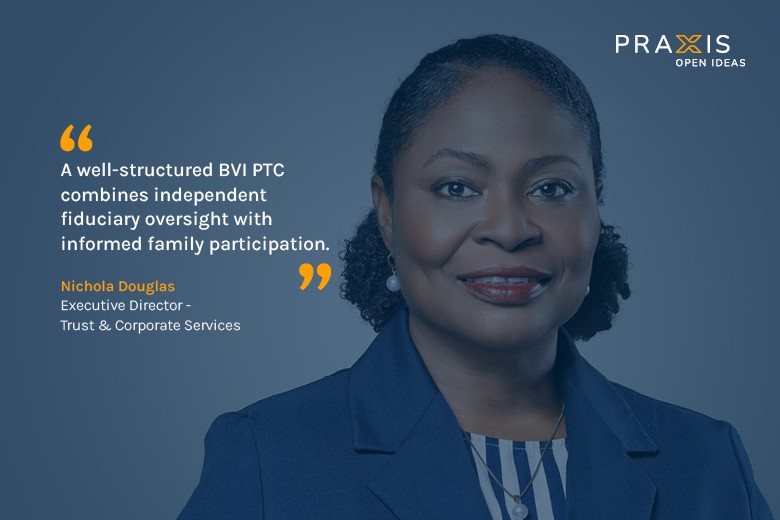
While trusts remain a central tool, many entrepreneurial families face a common challenge: balancing effective fiduciary oversight with the knowledge and experience that sits within the family itself. The BVI PTC was developed to address that balance.
Operating under the BVI's exempt PTC regime, a qualifying company may act as trustee without requiring a full trust licence. Rather than excluding the family from governance, a PTC enables them to remain closely involved while preserving the trustee's fiduciary responsibilities.
The board can be tailored to reflect the family's governance needs, bringing together family members, trusted advisers and independent professionals. This is particularly valuable where trusts hold operating businesses, significant investment portfolios or other complex assets, allowing trustee decisions to benefit from commercial understanding alongside independent fiduciary judgement.
For families, family offices and their professional advisers, a PTC provides continuity, flexibility and stronger alignment between trust administration, business succession and long-term wealth preservation.
The regulatory framework
The BVI's regulatory framework allows qualifying companies to act as PTCs without obtaining a full trust licence, provided they satisfy the statutory exemption criteria.
This enables families to establish a dedicated trustee vehicle without the regulatory burden associated with carrying on trust business for the public, while preserving appropriate safeguards through the involvement of a licensed registered agent.
Although exempt from licensing, a PTC must still be properly established, administered and governed, with appropriate corporate records, compliance procedures and ongoing oversight.
To qualify, a PTC must satisfy several requirements, including:
- being incorporated as a company limited by shares or guarantee and entered on the BVI Register of Companies
- stating in its memorandum and articles of association that it is a Private Trust Company, including 'PTC' within its corporate name
- appointing a registered agent holding a Class I trust licence
- acting only in respect of unremunerated trust business and/or related trust business
- not soliciting trust business from the public or conducting trust business outside the permitted statutory categories.
The registered agent plays an important role in ensuring the company continues to satisfy the applicable regulatory requirements. While there is no requirement for locally resident directors, careful consideration should be given to board composition to ensure the right balance of expertise, independence and effective decision-making.
When is a PTC appropriate?
A Private Trust Company can be particularly effective where:
- trusts hold operating businesses or other closely held assets requiring informed oversight
- family members possess specialist commercial knowledge that can contribute to trustee decision-making
- wealth is held across multiple jurisdictions or ownership structures
- several family trusts would benefit from a consistent governance framework
- a family office wishes to align trustee decision-making more closely with broader wealth planning objectives.
Benefits and practical considerations
A PTC is not simply an alternative trustee appointment – it represents a long-term governance model.
By establishing a dedicated trustee vehicle, families can create greater continuity across generations, support informed decision-making and provide a consistent framework for managing businesses, investments and changing family dynamics.
Although establishing and administering a PTC involves additional cost, many families view this as an investment in governance rather than an administrative expense. The value lies not only in the structure itself, but in creating a decision-making framework that is better aligned with the family's assets, succession objectives and long-term vision.
Equally, a PTC should not be seen as a means of retaining unfettered influence over trust assets. Its effectiveness depends on thoughtful planning, appropriate board composition and clearly documented governance arrangements.
Families and their advisers should consider issues such as conflicts of interest, reserved powers, decision-making procedures, record-keeping and ongoing regulatory obligations from the outset.
How Praxis can help
At Praxis, we work with families, family offices and professional advisers to establish and administer BVI PTCs that support effective governance over the long term.
Our services include company incorporation, registered agent and registered office (RORA) services, corporate administration, director and officer services, and ongoing governance support.
Working alongside our clients' legal, tax and investment advisers, we help ensure PTC structures remain practical, compliant and aligned with wider succession planning and wealth preservation objectives.
Beyond administration, we also help families develop governance frameworks that evolve alongside changing ownership structures, family dynamics and investment strategies.
If you would like to discuss whether a BVI Private Trust Company may be appropriate for your clients or their wealth structures, please contact Nichola Douglas.
Please note that this article is intended to provide a general overview of the matters to which it relates. It is not intended as professional advice and should not be relied upon as such. Any engagement in respect of our professional services is subject to our standard terms and conditions of business and the provision of all necessary due diligence. © Praxis 2026
Key contact