

Maltese Segregated Cell Foundations: a flexible structure for succession planning and family wealth governance
22 July 2026
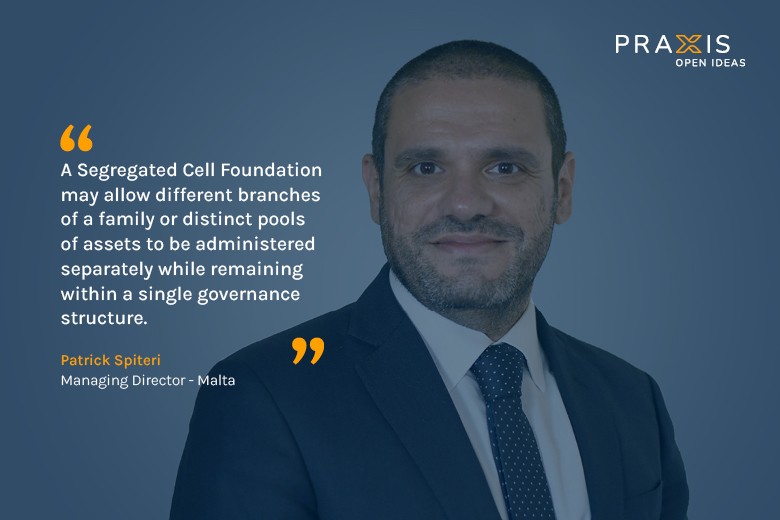
As international families become increasingly global and wealth structures become more sophisticated, advisers may need structures that support succession planning, asset segregation and effective family governance. Maltese Segregated Cell Foundations can provide a practical way to administer different branches of a family or distinct pools of assets within a single legal framework while maintaining statutory separation between them.
Nearly two decades after Malta introduced its modern foundations regime through ‘Act XIII of 2007 (the Civil Code (Amendment) (No. 2) Act)’, the jurisdiction has developed one of Europe's most established legal frameworks for private foundations.
Combining elements of Roman law, the Napoleonic Code and English common law, Malta offers international families, family offices and their advisers a wealth structuring framework that can support flexibility, governance and long-term succession planning.
Types of Maltese foundations
Maltese law provides for two principal types of foundation:
- Private foundations – generally established for the benefit of named individuals or a defined class of beneficiaries.
- Purpose foundations – generally established to fulfil a specific purpose, including charitable or philanthropic objectives, rather than benefit identifiable beneficiaries.
Maltese foundations are generally not intended to conduct commercial trading activities directly, although they may hold commercial property, shares in companies and other income-generating assets, provided they remain passive owners. This can make Maltese foundations relevant to wealth preservation, succession planning and the long-term stewardship of family assets, depending on the circumstances and the applicable legal and tax position.
Potential features of a Maltese Segregated Cell Foundation
- statutory segregation of assets and liabilities
- governance arrangements and statutory beneficiary protections
- flexible succession planning across multiple generations
- support for different investment strategies and risk profiles
- efficient administration within a single legal framework
- oversight through established governance mechanisms
Governance and beneficiary protections
One of the distinguishing features of Maltese foundation law is its emphasis on governance and accountability.
Foundation administrators are subject to statutory conflict-of-interest provisions, while beneficiaries may benefit from statutory protections and oversight mechanisms involving the Maltese courts. This framework is designed to support transparency and help ensure that the foundation operates in accordance with its stated objectives and the founder's intentions.
Many foundations also appoint a Supervisory Council, which can provide an additional layer of oversight while allowing families to retain an appropriate degree of strategic input into the foundation's long-term direction.
Segregated Cell Foundations
One of Malta's most innovative developments is the introduction of the Segregated Cell Foundation (SCF).
The concept builds on Malta's broader expertise in statutory asset segregation, reflected in legislation governing Incorporated Cell Companies (ICCs), Protected Cell Companies (PCCs) and the Malta Aircraft and Ship Passive Cell Company (MAPCC) framework. Together, these demonstrate Malta's development of flexible legal structures for different asset classes and ownership requirements.
Within a Segregated Cell Foundation, multiple cells may be established under a single foundation, with each cell constituting a separate patrimony. Although individual cells do not have separate legal personality, the assets and liabilities attributable to each cell are intended to be legally segregated from those of other cells and from the foundation's general assets, subject to the applicable legal framework.
This statutory segregation may be useful where a family wishes to separate operating businesses, investment portfolios, real estate holdings or distinct family branches while retaining a single governance framework. Each cell may support its own investment strategy, succession arrangements or beneficiary class, helping to limit cross-cell exposure, subject to the applicable legal framework.
When might a Segregated Cell Foundation be appropriate?
A Segregated Cell Foundation may be relevant where clients require:
- different governance arrangements across family branches
- separate investment strategies or risk profiles for different generations
- ring-fencing of distinct pools of assets within a single ownership structure
- succession planning that accommodates multiple beneficiary groups
- a streamlined governance framework without establishing multiple standalone structures
In practice, this might include entrepreneurial families with several operating businesses, families managing investment portfolios with differing objectives or family offices seeking to separate distinct asset classes while maintaining consistent governance across the wider structure.
In practice, Segregated Cell Foundations may be relevant where families want the efficiencies of a single structure while retaining flexibility to accommodate differing investment objectives, governance arrangements or succession plans.
A flexible structure for multi-generational wealth
As family wealth becomes more diverse and governance requirements evolve, advisers may consider structures that combine flexibility with long-term continuity.
The Maltese Segregated Cell Foundation can bring together statutory asset segregation, governance and succession planning within a single legal framework. For advisers supporting internationally mobile families, entrepreneurs and family offices, it may offer an established approach to administering and stewarding wealth across generations, where appropriate to the relevant circumstances.
Get in touch
To discuss how Praxis can support the administration and governance of Maltese foundation structures, please get in touch with Patrick Spiteri.
Please note that this article is intended to provide a general overview of the matters to which it relates. It is not intended as professional advice and should not be relied upon as such. Any engagement in respect of our professional services is subject to our standard terms and conditions of business and the provision of all necessary due diligence. This insight was developed with the support of AI tools, with analysis, interpretation and final editorial decisions made by our team. © Praxis 2026
Key contact